Scroll down
to add colours!
plattr.
"Redefining food court experiences."
PROJECT OVERVIEW
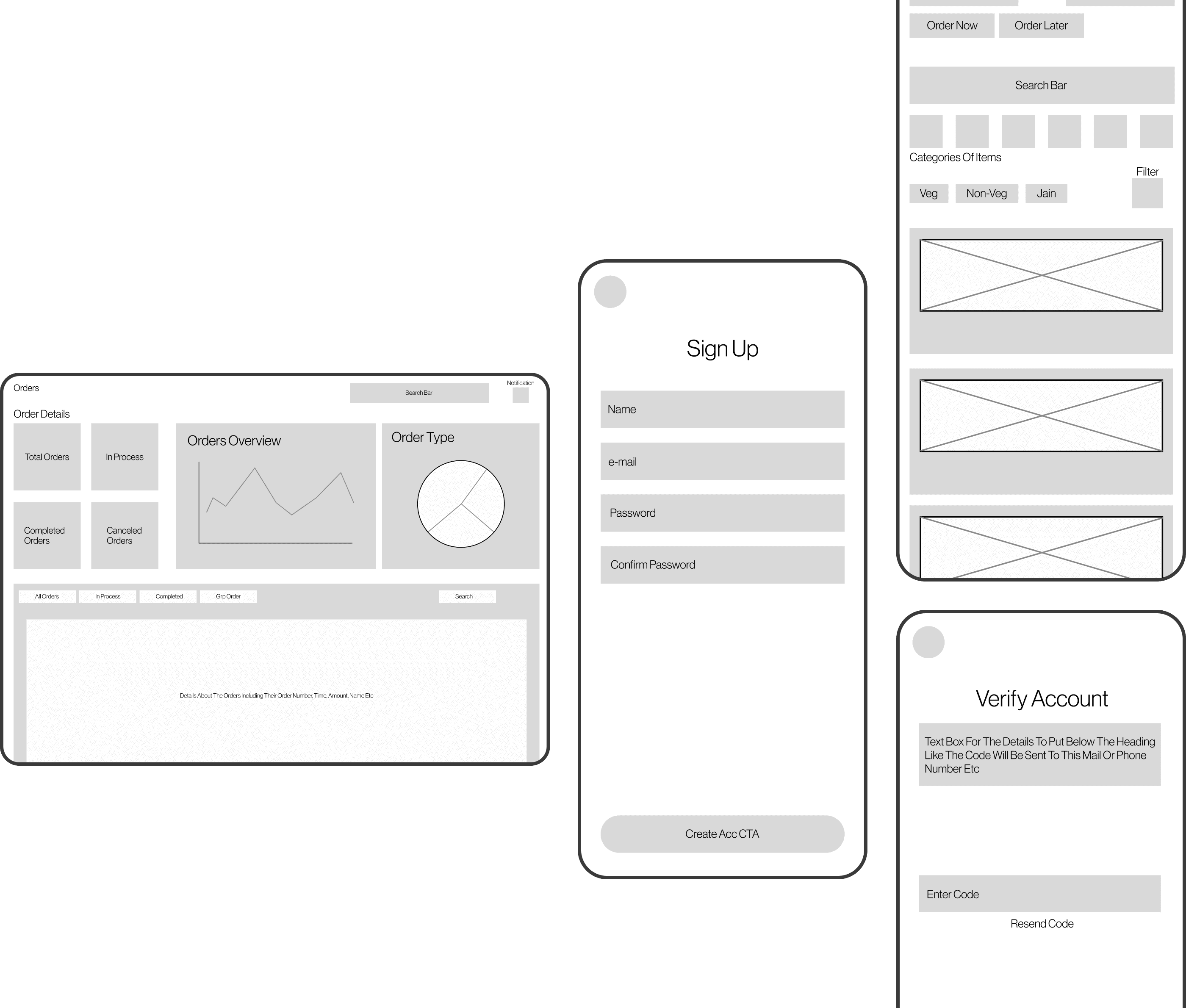
Plattr revolutionizes food court dining by making it fun and frictionless.
Skip the stall-hopping, long waits, and multiple payments with quick,
unified ordering across outlets, plus a streamlined merchant dashboard
for effortless sales, menu, and promo management.
Skills
User Research
Service Design
Visual Identity Design
Interface Design
Timeline
8 weeks
MY ROLE
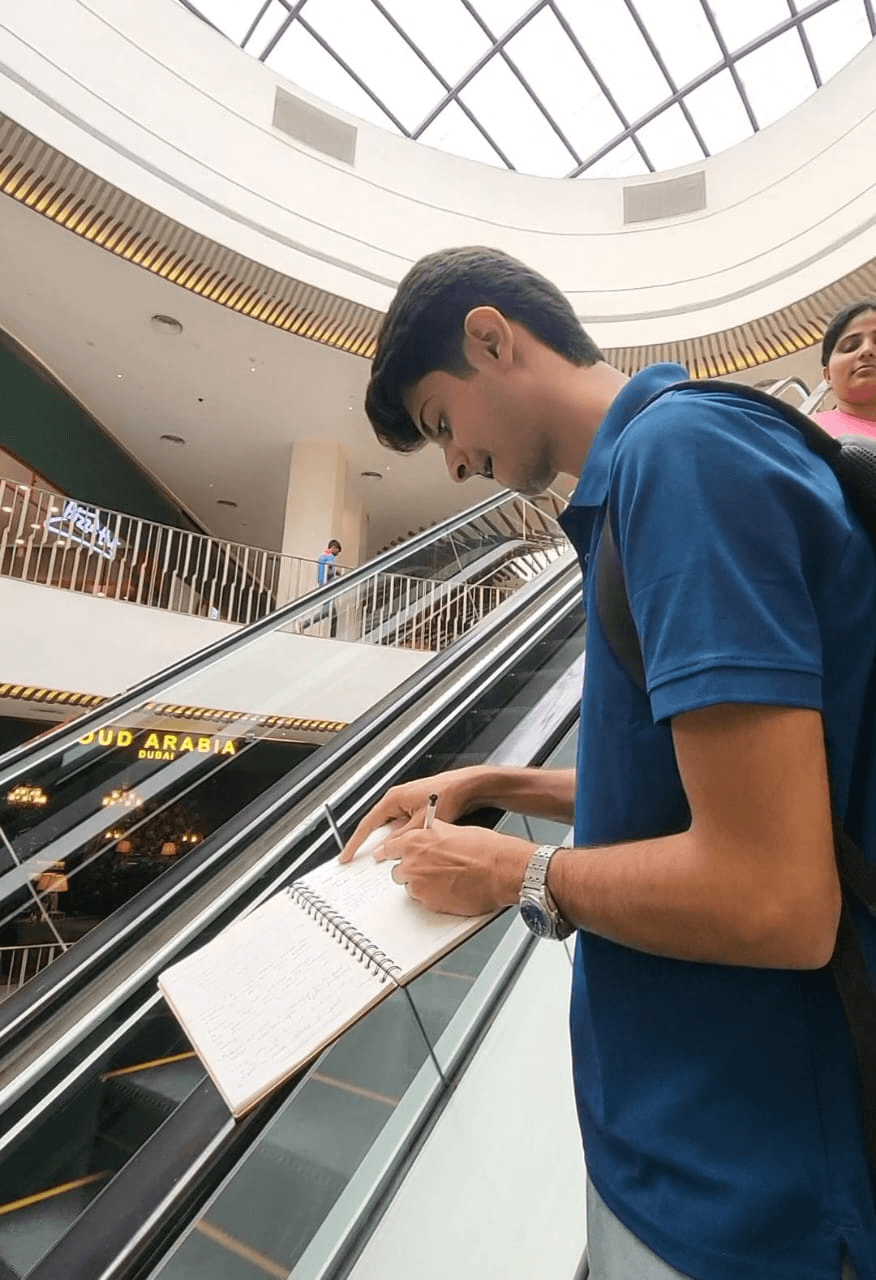
I began by digging into existing research and listening to users
through interviews to uncover what truly mattered. From there,
I shaped the service experience end-to-end and brought it to
life through a refined visual identity and interface design.
UNDERSTANDING THE PROBLEM
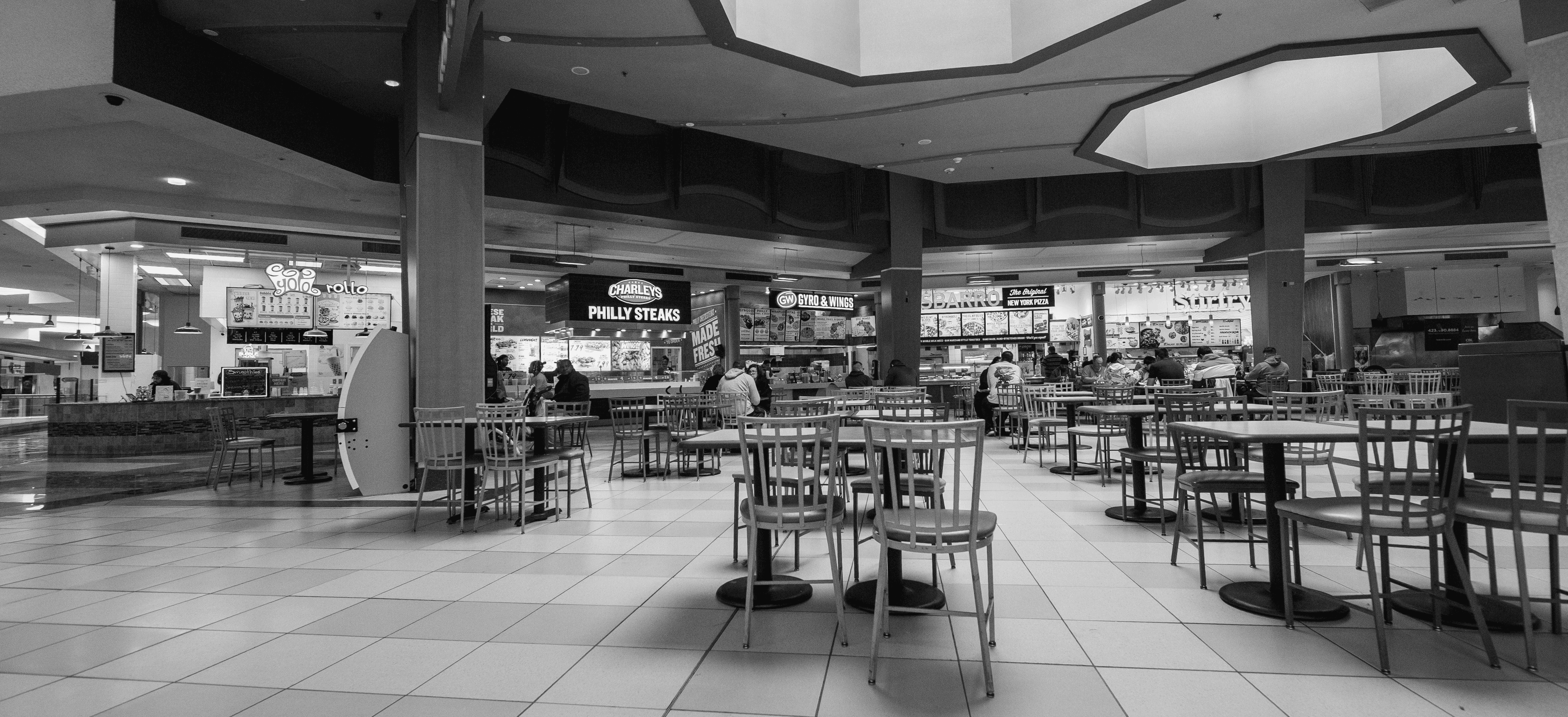
Imagine Priya dashing through Ahmedabad's hectic food court at lunch,
queuing endlessly at three stalls for thali, chaat, and juice while juggling
crumpled notes as her food chills. Meanwhile, vendors scramble amid
miscommunications during peak delivery rushes, fumbling orders and
losing track of payments. Plattr ends this chaos for users and merchants
alike, banishing stall-hopping waits and order mix-ups.
KEY CHALLENGES
Endless Queues and Stall Hopping
Payment Chaos
Vendor Miscommunication
PROJECT OBJECTIVES
01.
Deliver user-centered experiences
across the food court ecosystem.
02.
Optimize end-to-end ordering and
payment flows for efficiency and delight.
03.
Empower merchants with seamless tools
for order management and collaboration.
04.
Drive measurable satisfaction and retention
for customers and vendors alike.
Secondary Research from Existing Literature
Interviews & Observational Studies
Desk Research- Market Study & Competitors
RESEARCH APPROACH
EXISTING LITERATURE
ANALYSIS
Began with secondary research by
reviewing existing market solutions.
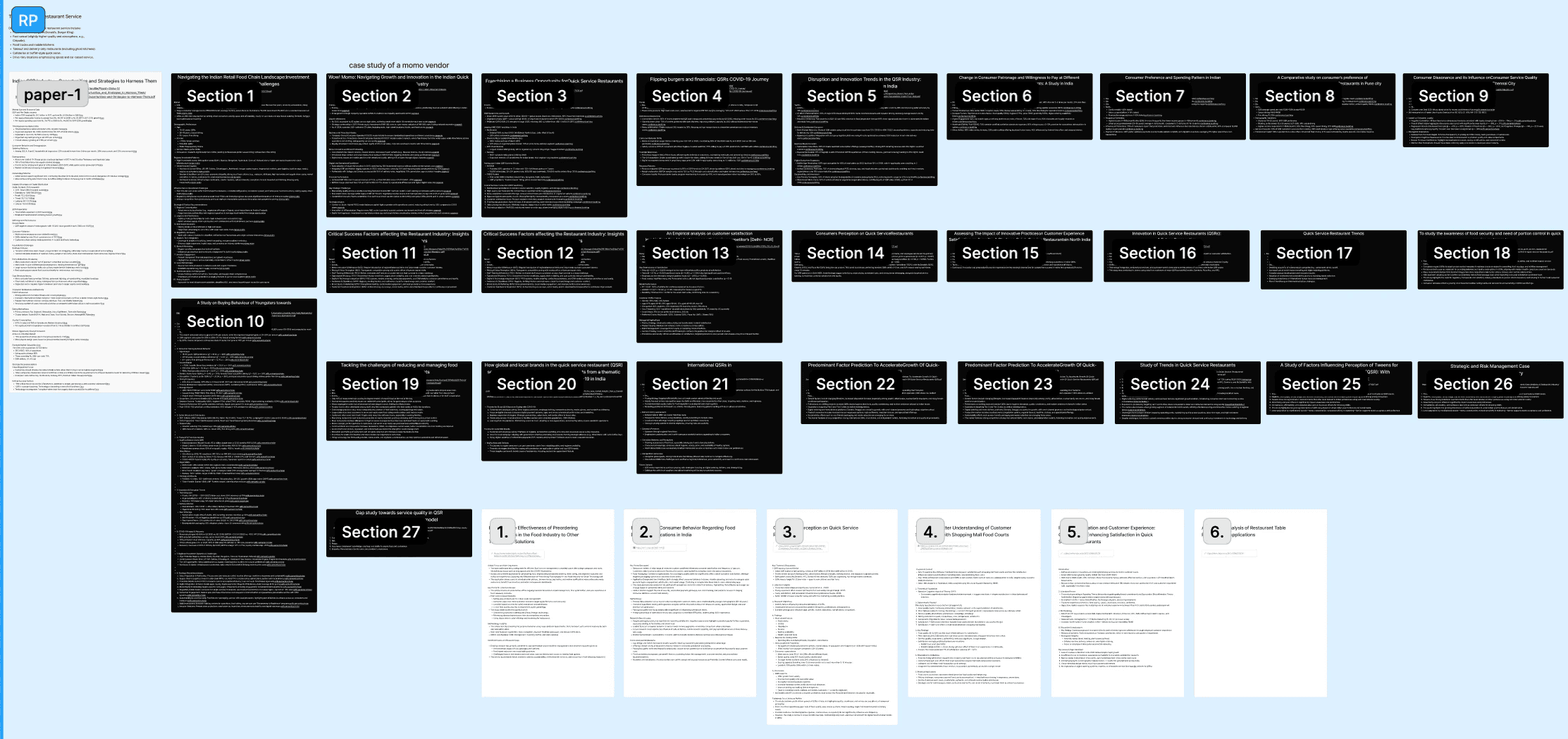
TAP TO VIEW FULL RESEARCH
USER INTERVIEWS
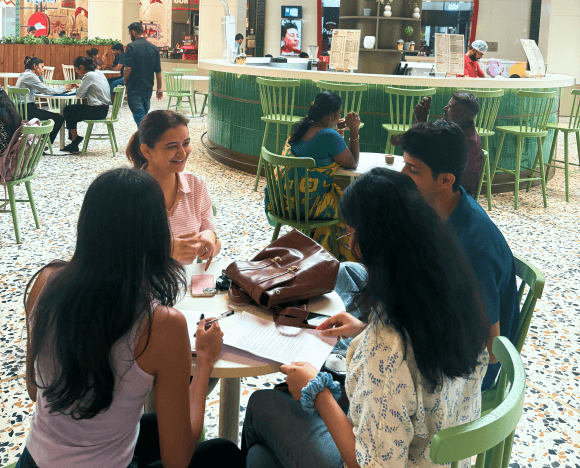
Interviewed 27 users across customers,
vendors, kitchen and cleaning staff.
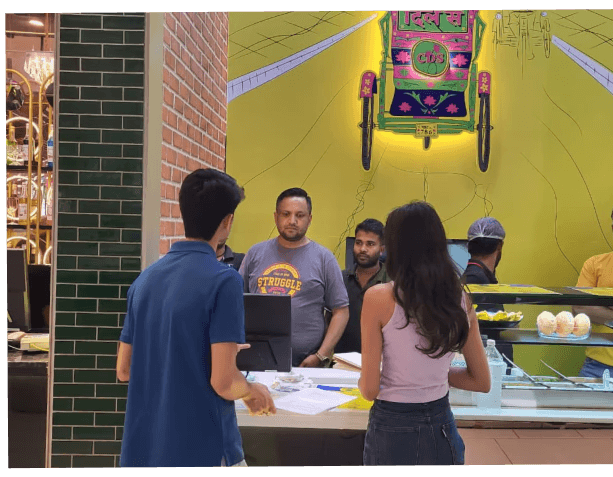
ETHNOHRAPHIC OBSERVATIONS
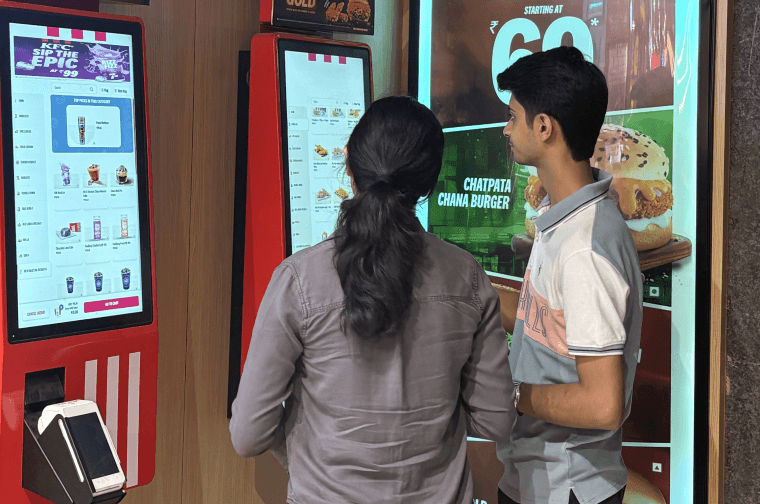
Conducted ethnographic observations in live food courts.
PHYSICAL MODEL
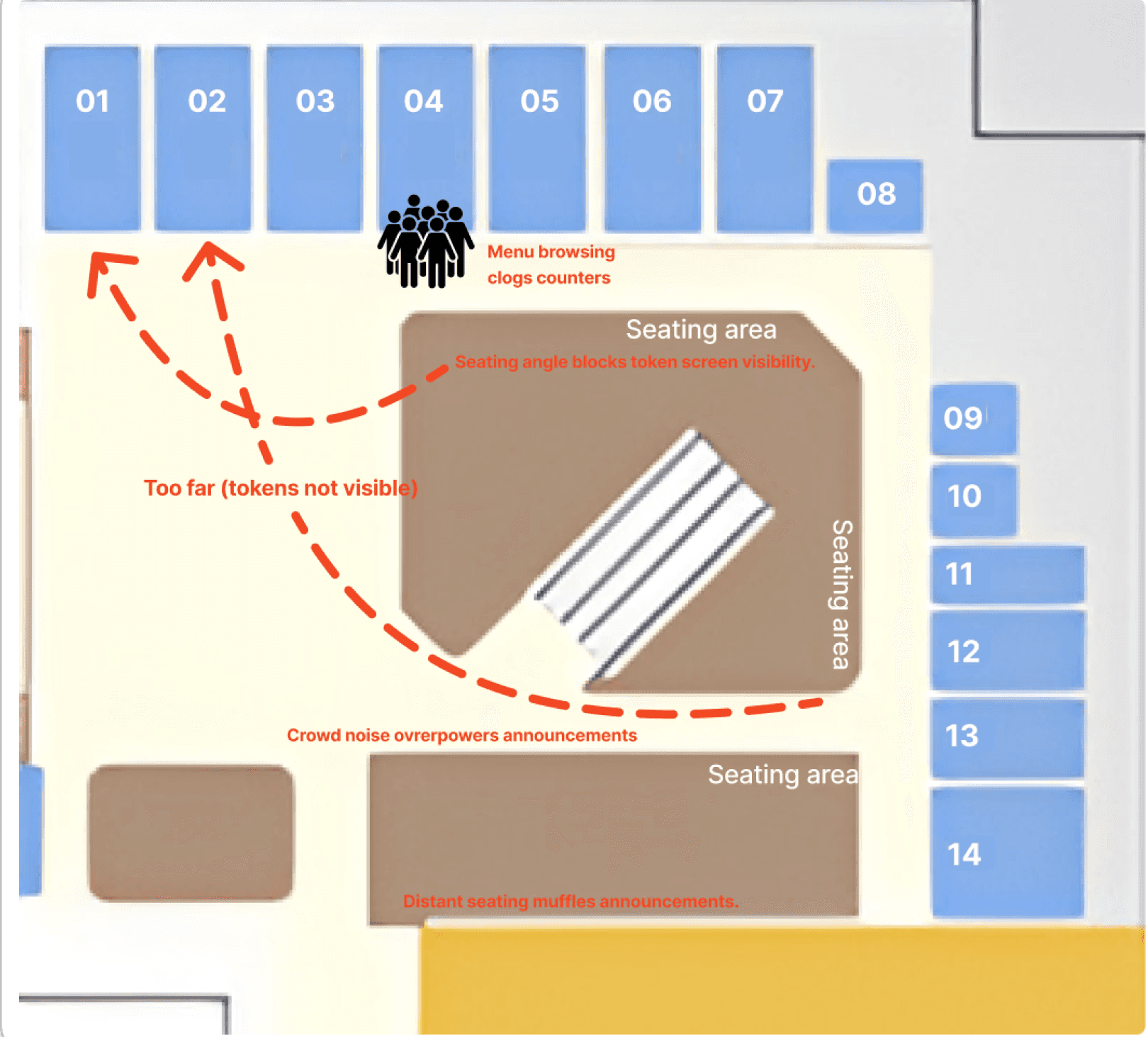
This physical flow map is based on
one of the food courts we visited
during our research. We observed
and mapped how customers actually
move through the space, from browsing
to ordering to pickup and seating.
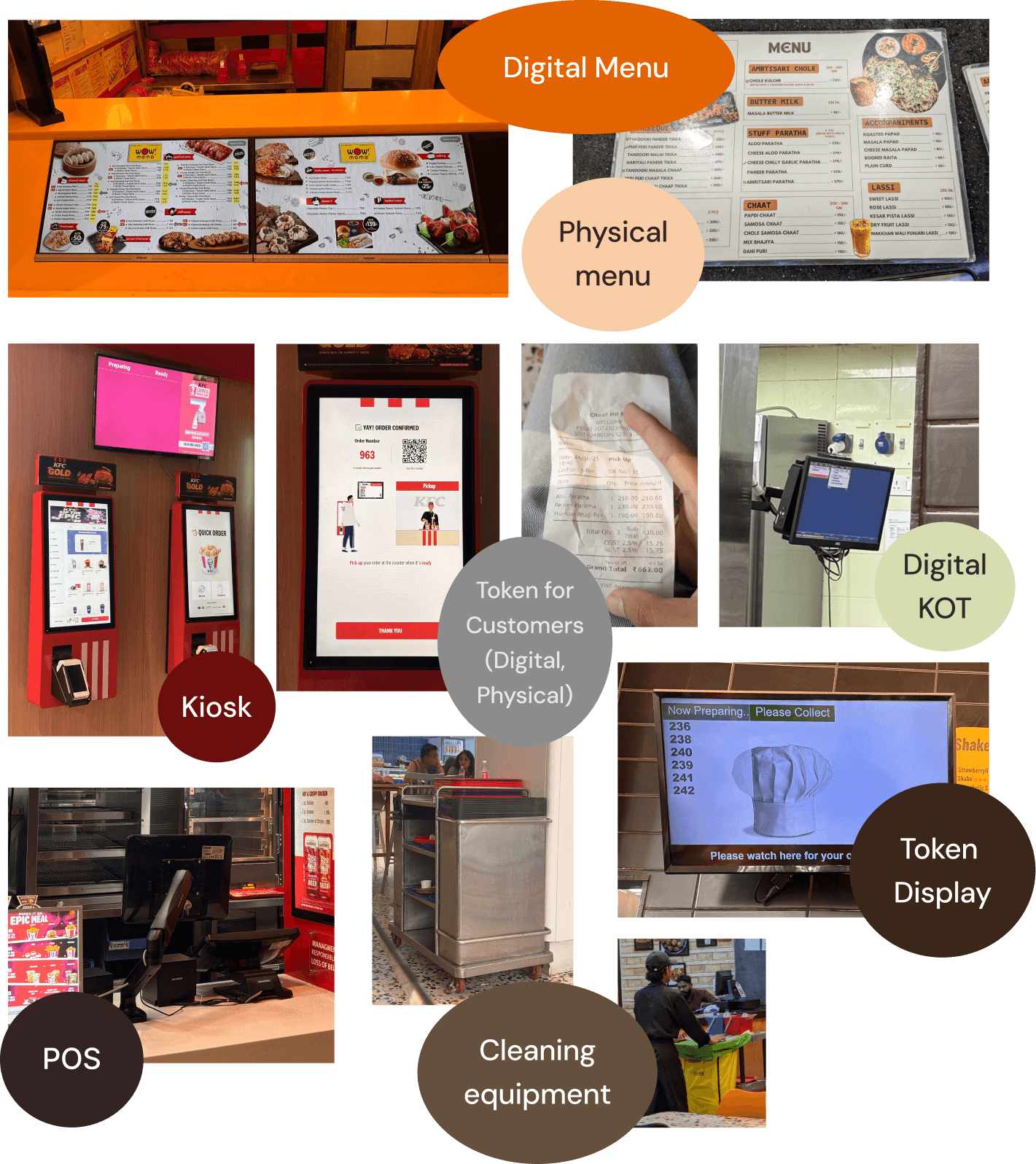
ARTEFACTS
The research identified fragmented
physical & digital artefacts; physical
menus, kiosks, POS machines, tokens
and status displays that revealed how
customers navigate isolated systems
without combined information across
multiple vendors.
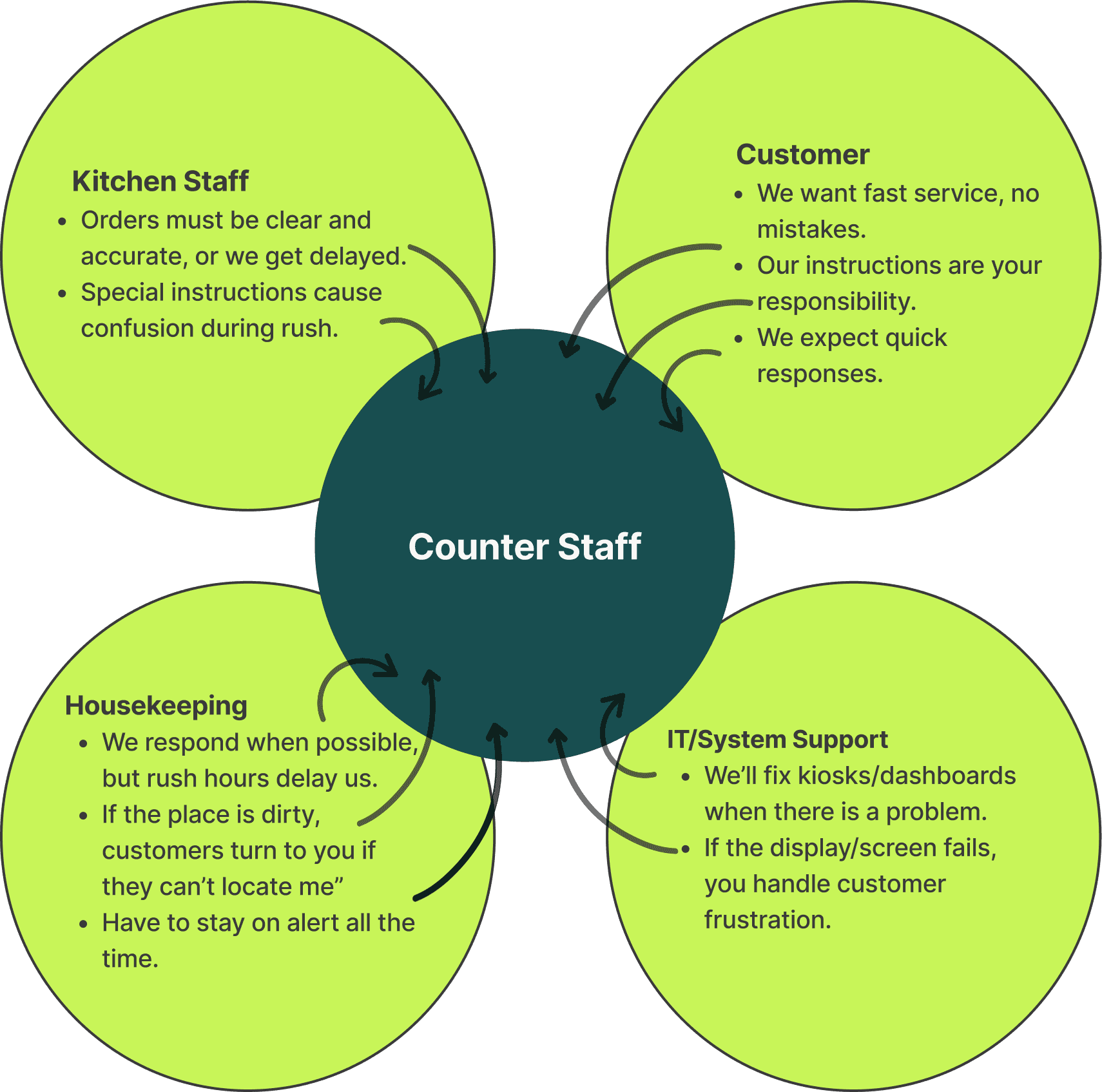
CULTURAL MAPPING
The cultural mapping revealed competing
priorities among counter staff, kitchen staff,
customers and IT support. It illustrates how
individual stakeholder faces conflict within
the current fragmented system.
TAP TO VIEW FULL DATA
"The patterns we uncovered became our
turning point, guiding design with confidence"
01.
Food court crowds spike during weekends
and peak meal hours.
02.
Current F&B digital solutions in India focus
mostly on corporates or office spaces.
03.
Multi-stall ordering is still an underserved need.
Vendors face operational inefficiency and delays.
04.
Digital adoption is increasing, there is a market
readiness for a digital transformation.
KEY INSIGHTS
(What did we find out)
MARKET ANALYSIS
(Understanding the market we are targeting)
TAM
$9-10 billion USD(2025)
SAM
$1.5-2 billion USD(2025)
SOM
$1-1.5 billion USD(2025)
Market Segment
Market B2B2C I Food & Beverage
TAM-SAM-SOM
All organised food courts and QSRs in Tier 1 & 2 Indian cities with potential to
adopt a digital service platform. Market size: $9–10 B.
Urban food courts already moving towards digital ordering and management
systems. Market size: $1.5–2 B.
Early adopter venues reachable within 1–3 years of rollout. Market size: $1.5–2 B (2025)
COMPETITIVE LANDSCAPE
To understand the current market ecosystem, we analyzed existing
solutions including both direct and indirect competitors.
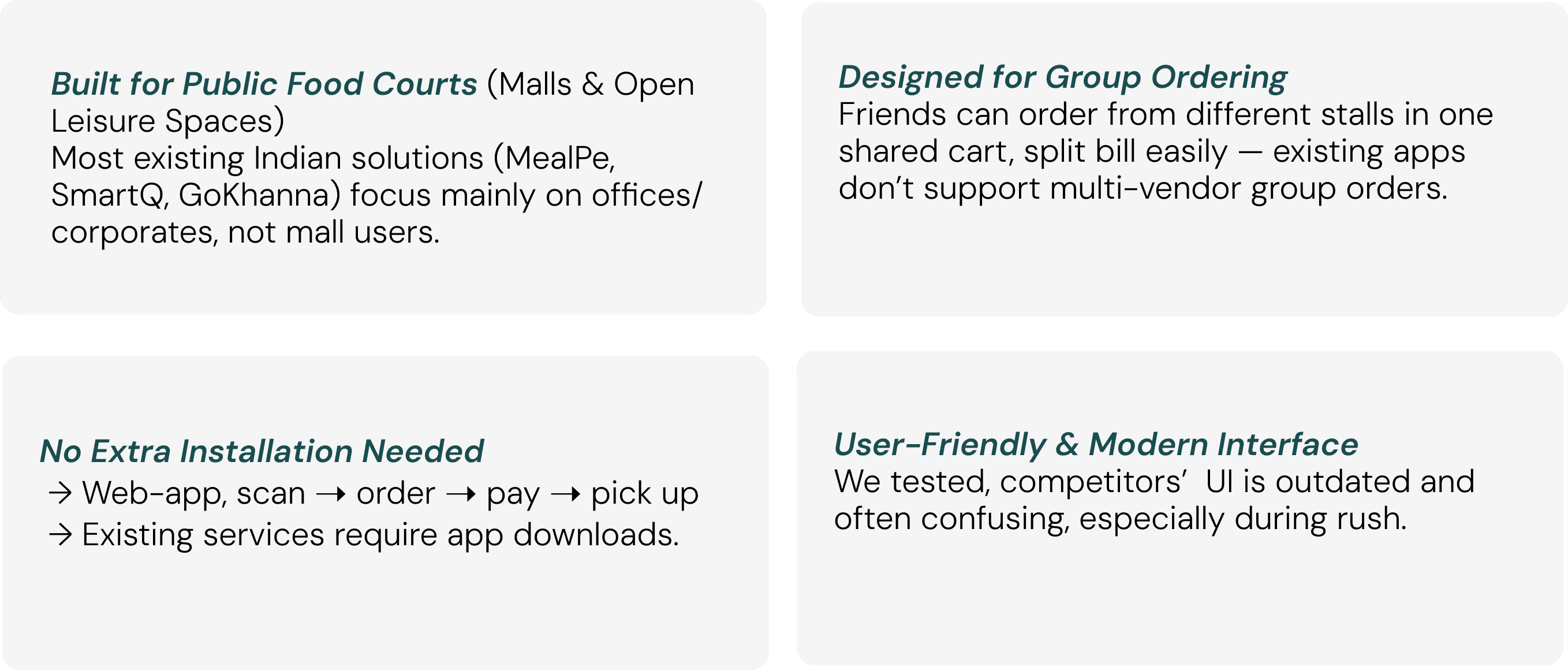
There is no such service in the Indian market currently that enables
multi-vendor group ordering + unified bill + unified ordering in food courts.
Existing players like mealpe primarily cater to corporate offices or private
cafeterias, not high-traffic malls or public food courts.
FINDINGS:




DETAILED COMPETITIVE LANDSCAPE
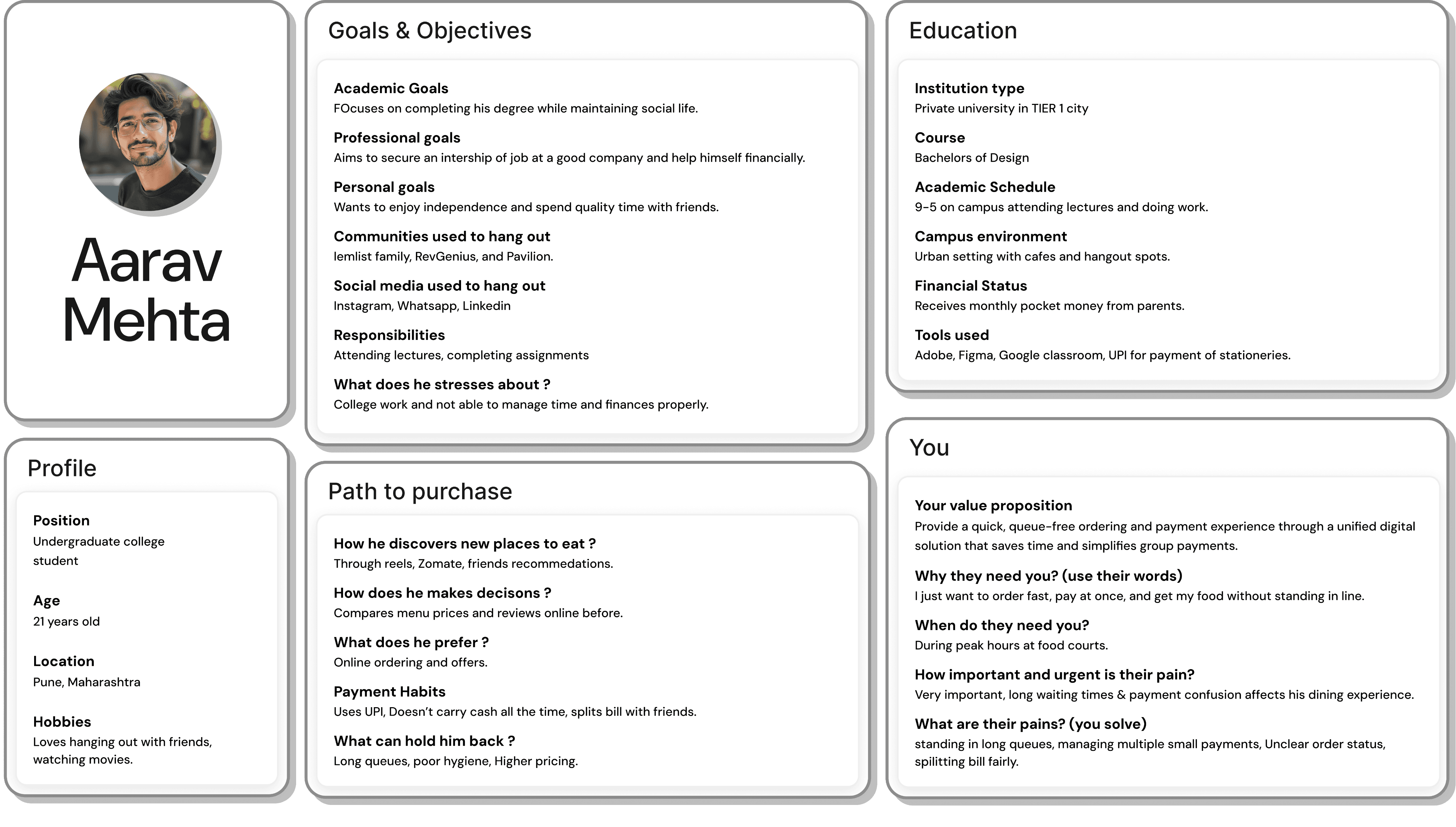
ICP- IDEAL CLIENT PROFILE
Ideal client profiles were developed by analysing contextual artefacts
and stakeholder interactions, helping us identify the specific types of
customers and vendors who would gain the most value from a
redefined food court service.
We developed various ICP’s including:
Student/Professional Visiting food court
Vendor
Kitchen staff
Cleaning staff
VIEW ALL ICPs
"Now begins the analysis phase, connecting
patterns to meaningful opportunities"
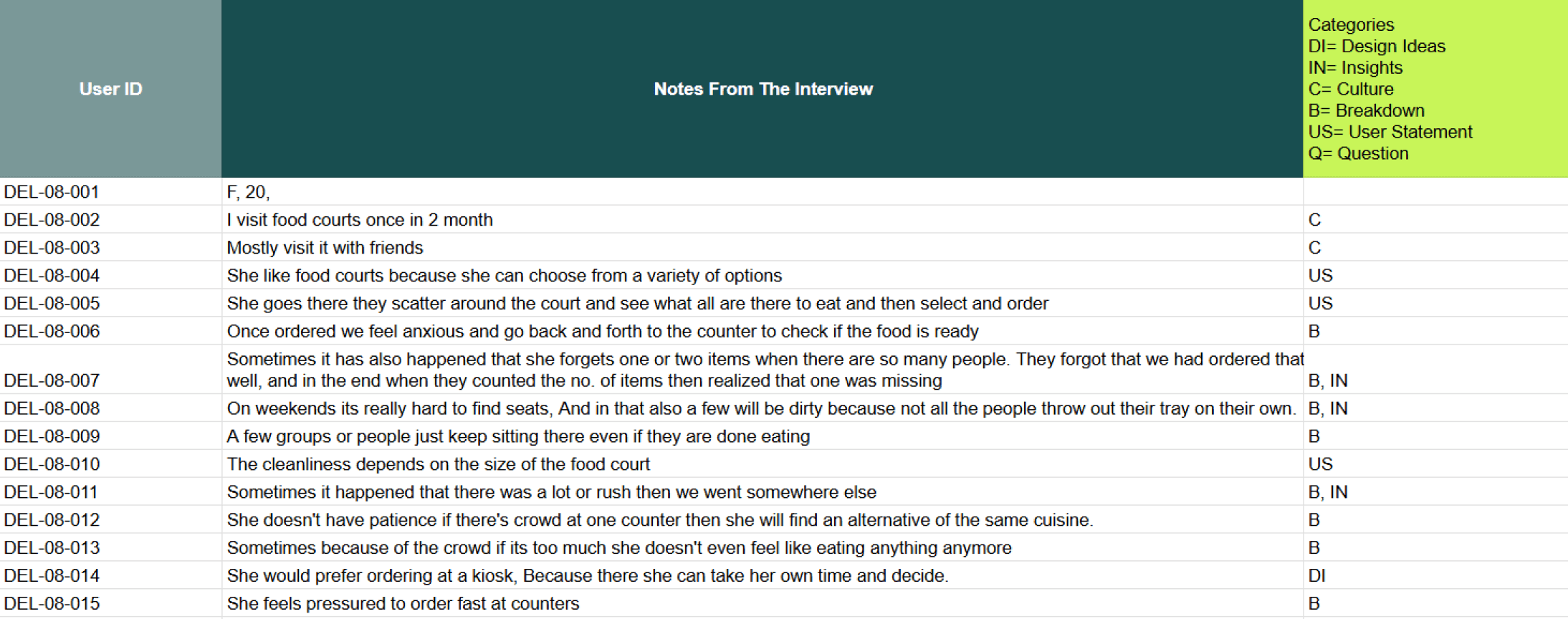
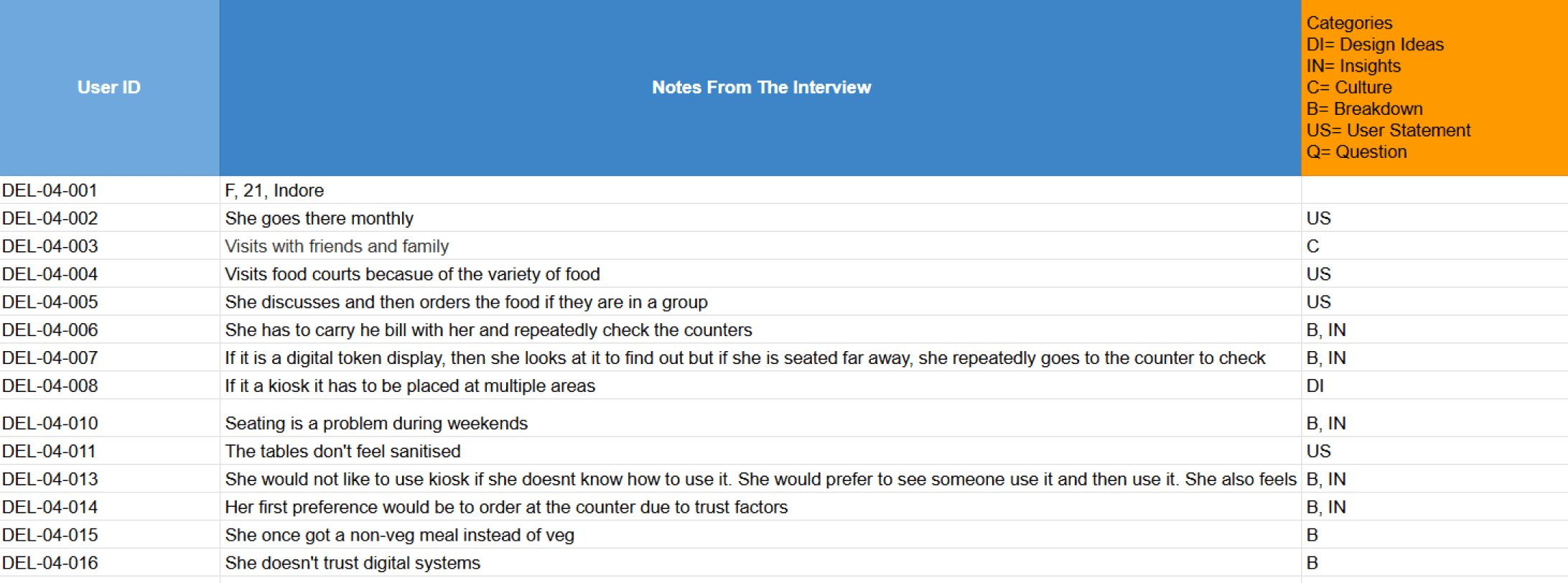
INTERVIEW INTERPRETATIONS
We interpreted and categorised every response into:
Opportunity
User Statement
Design Idea
Insights,
Culture
Breakdown
Question.
VIEW FULL INTERVIEWS
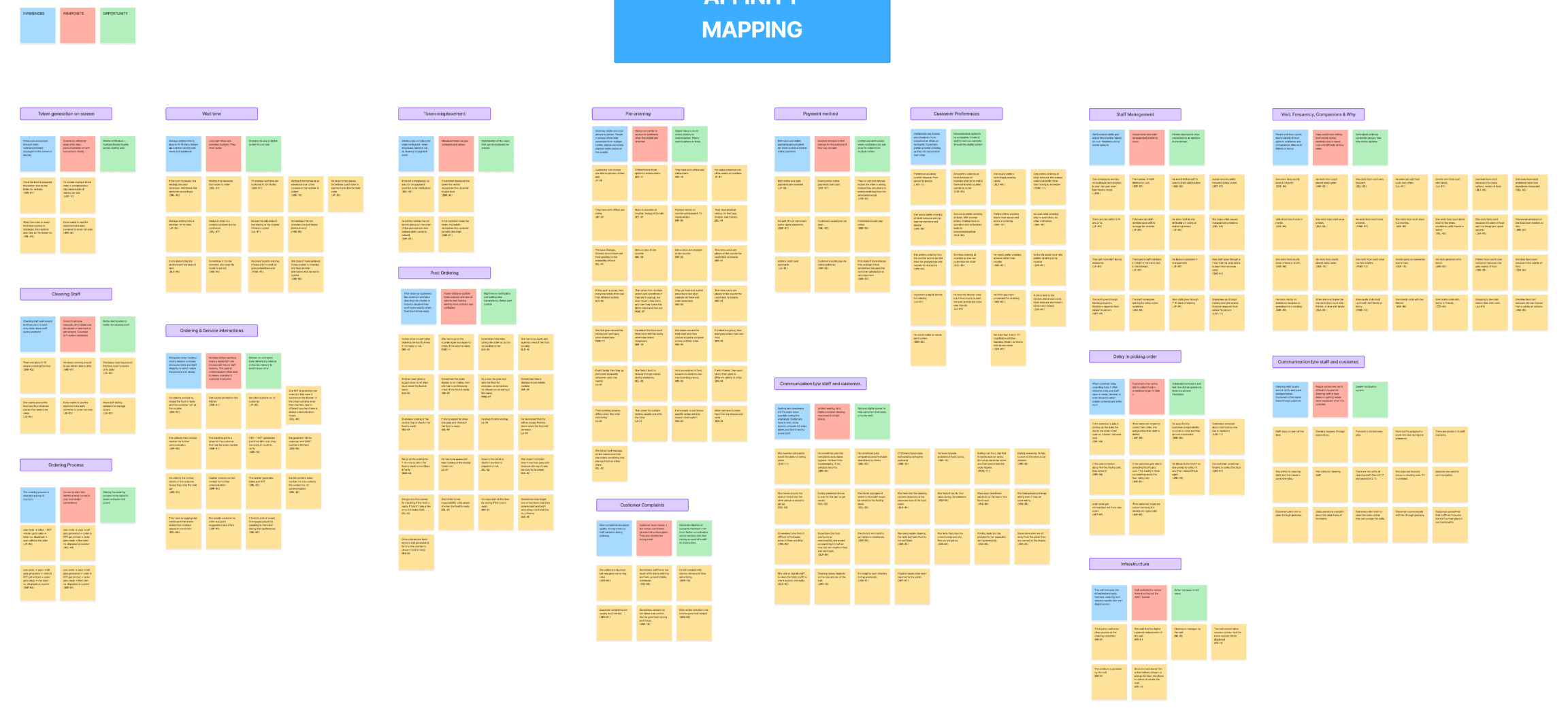
AFFINITY MAPPING
We organised the research findings to uncover the common
pain points and opportunities across all stakeholder.
VIEW FULL
KEY OUTCOMES
(From Affinity Mapping)
01.
Recurring issues in ordering and token
management include delays, confusion,
and lack of real-time updates.
02.
Technology should unify order tracking, menu
management, and workflow for customers
and staff.
03.
Users consistently prefer transparency, fast
service, and immediate feedback during the
ordering process.
04.
Staff need better training and clearer
communication to reduce mistakes during
busy hours.
05.
Customer frustration is often caused by
unclear status updates and long waits in
multiple queues.
06.
Vendors struggle with high order volumes
when they lack unified visibility and auto-
-mation for management.
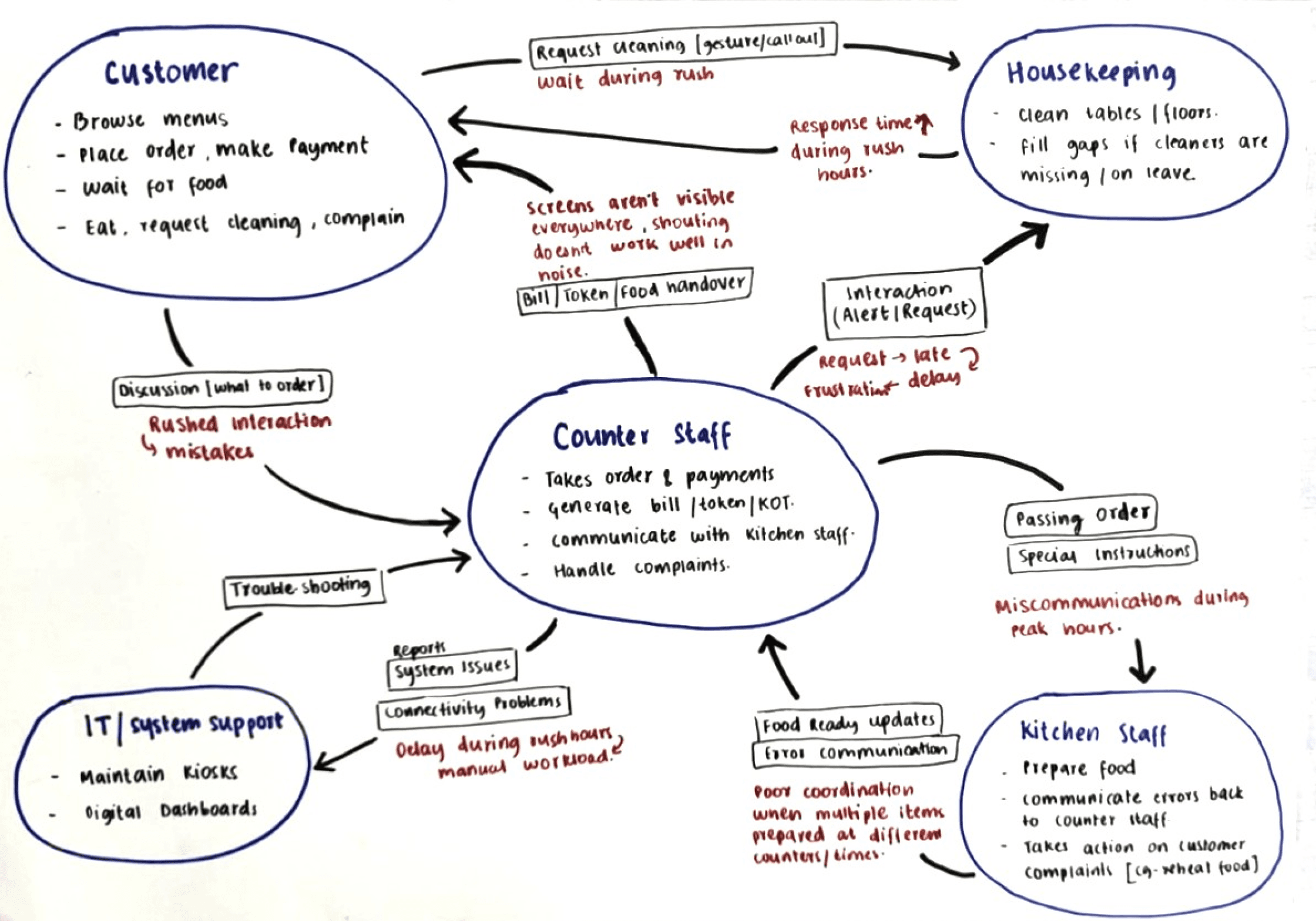
WORK FLOW MODEL
To understand how the current food court system operates,
we mapped workflows for each stakeholder - customers,
counter staff, kitchen staff, and housekeeping.
This helped us visualise:
How tasks flow from one role to another
Where breakdowns, delays, and confusion occur
CURRENT USER SCENARIO
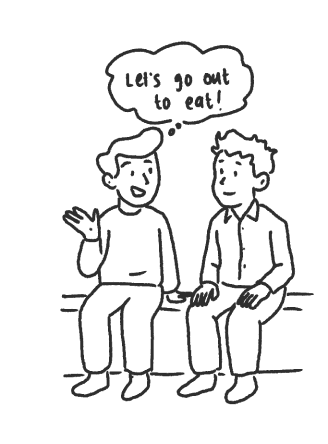
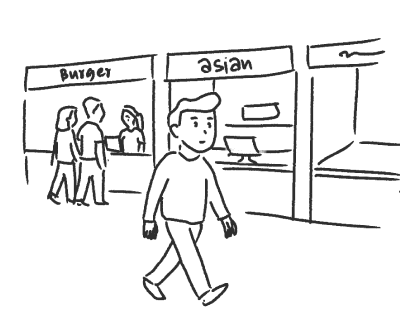
This storyboard illustrates the common challenges and experiences
faced by users in mall food courts today.

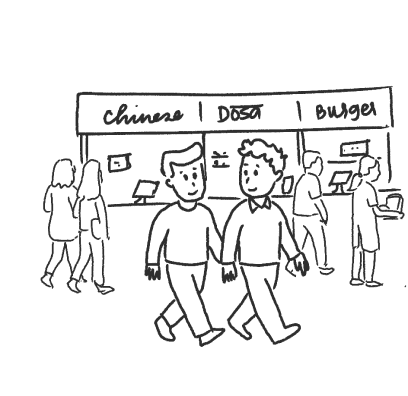
looking at his
favourite cuisine
outlet
Journey
in
Food
Court
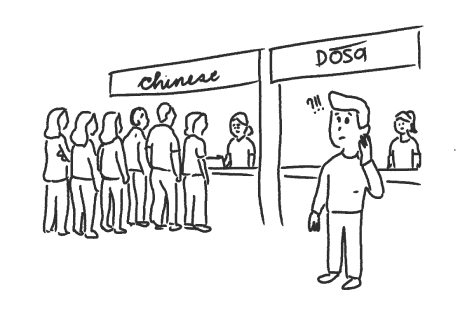
Its a lot of
crowd because
it’s weekend


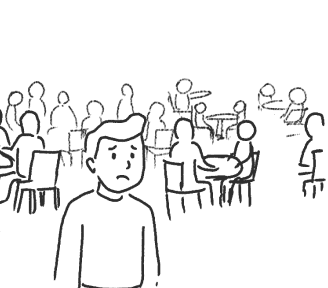
Popular stalls are crowded

Hard to access menu at other outlets.
They wait impatiently for their order.

Ends up ordering
at a different outlet
Looking for available
and clean seats
Seated far from outlet
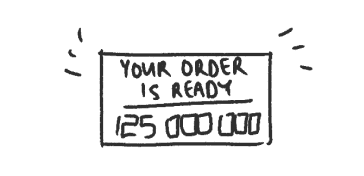
Order is ready !!

They couldn’t see or hear their order no.
Walks back and forth
to check if order is ready.


Enjoys their
food.
Collects his order
late.


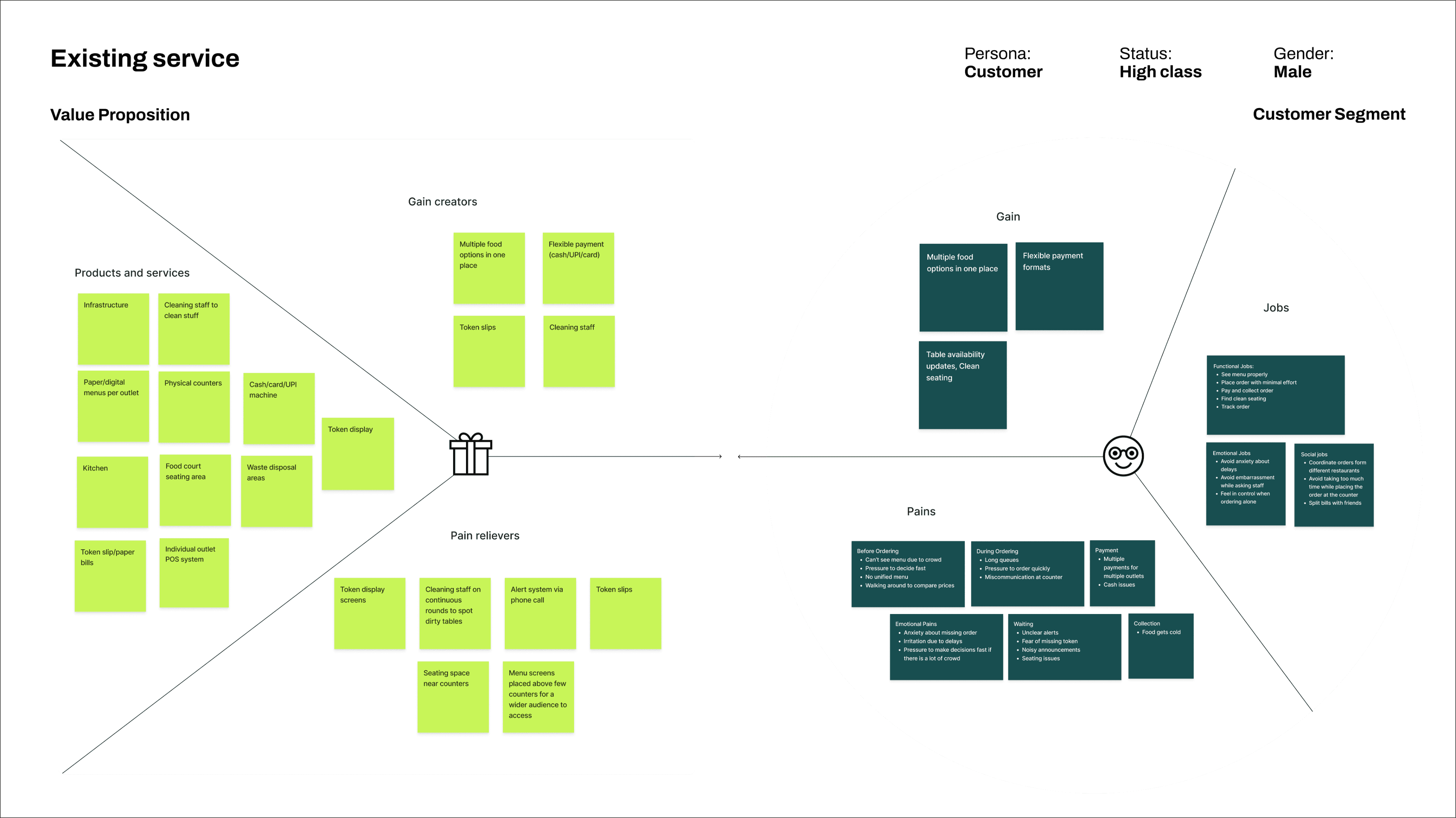
VALUE PROPOSITION
(Of Existing Service)
By analysing the existing food court experience, we identified what
customers currently value and pinpointed key areas for improvement
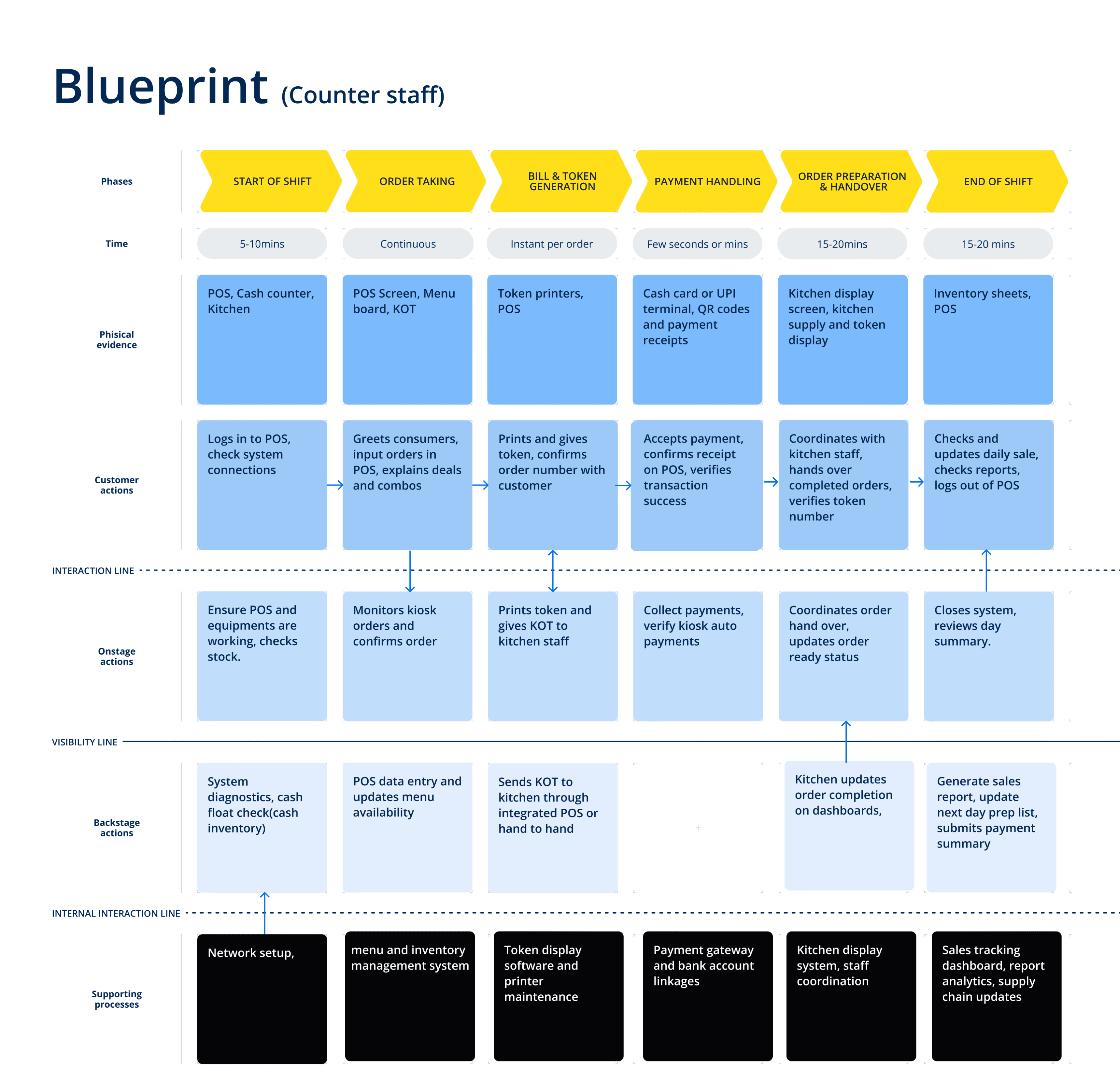
SERVICE BLUEPRINT
(Of Existing Service)
Mapped user actions and backend processes to identify gaps and
improve service flow.
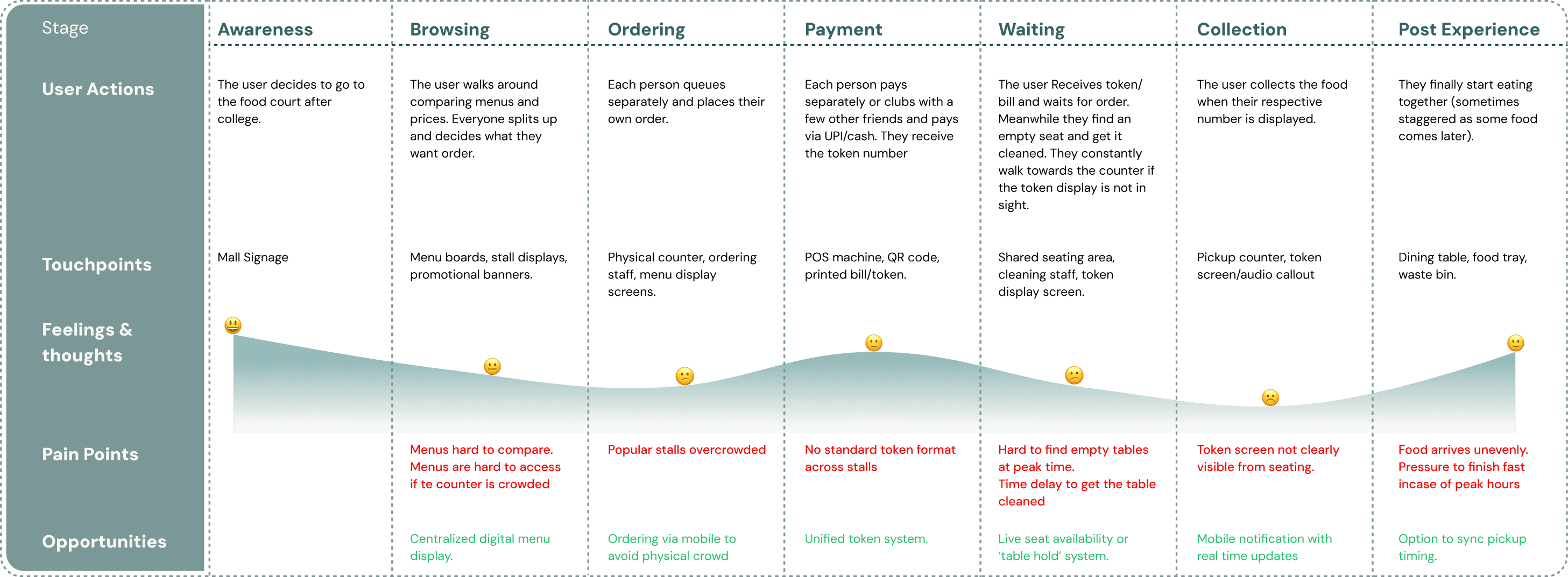
CUSTOMER JOURNEY MAP
(Of Existing Service)
CJM helped us understand the user’s entire experience,
pinpoint their frustrations, and identify key opportunities
for improvement.
Next, we narrowed the chaos into a
focused problem worth solving.
PROBLEM STATEMENT
Two core problem statements
emerged from our research.
01.
Food court customers need a quicker and
a more organized way to place and track
their orders from multiple restaurants bec-
-ause long queues, delayed updates, and
confusion during peak hours make their
experience stressful & time-consuming.
02.
Food court vendors need an efficient
way to manage orders, deals, inventory
& customer interactions because manual
coordination, high customer volume, and
unclear communication with kitchen staff
lead to delays and errors.
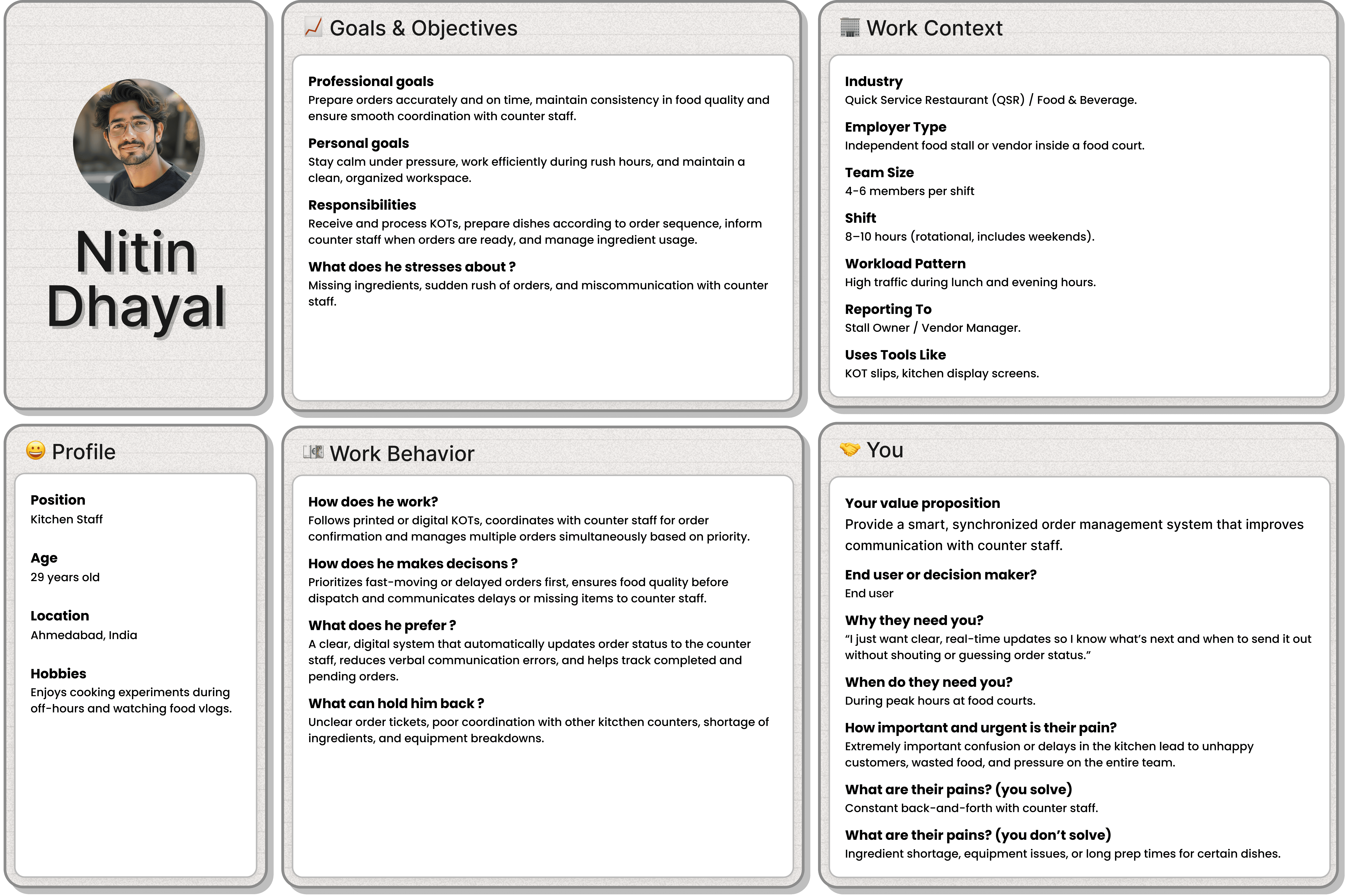
USER PERSONA
We identified two primary personas, Customer and Vendor,
as the core users of the service, along with a secondary
persona, Kitchen Staff, supporting the overall service flow.
PAIN POINTS &
OPPORTUNITIES
User challenges revealed clear opportunities for
service improvement.
Pain points
Long queues and noise block menus and cause mistakes.
Menus have outdated prices and missing details.
Separate bills at every stall complicate payment.
Unclear order displays lead to missed or delayed pickups.
Groups struggle to order, pay, and track items together.
Live order status reduces interruptions.
Peak hours, sales, and stock tracked for vendors.
Pre-order and pick up service
Consistent digital menus make comparing options quick and easy.
One simple bill for all stalls.
One basket, one payment—order from any stall without switching lines.
With the problem defined, we explored multiple
ideas to address user needs and service gaps.
PRIORITY METRICS
Ideas were filtered using an effort-impact framework to focus
on what matters most.
“Unified Ordering & Multi-Vendor Convenience”
“Cleaner Command Dashboard”
“Smart Table Availability Mapping System”
“Centralised Big Menu Boards or QR for Each Stall menu”
LOW
LOW
HIGH
EFFORTS
VALUE
HIGH
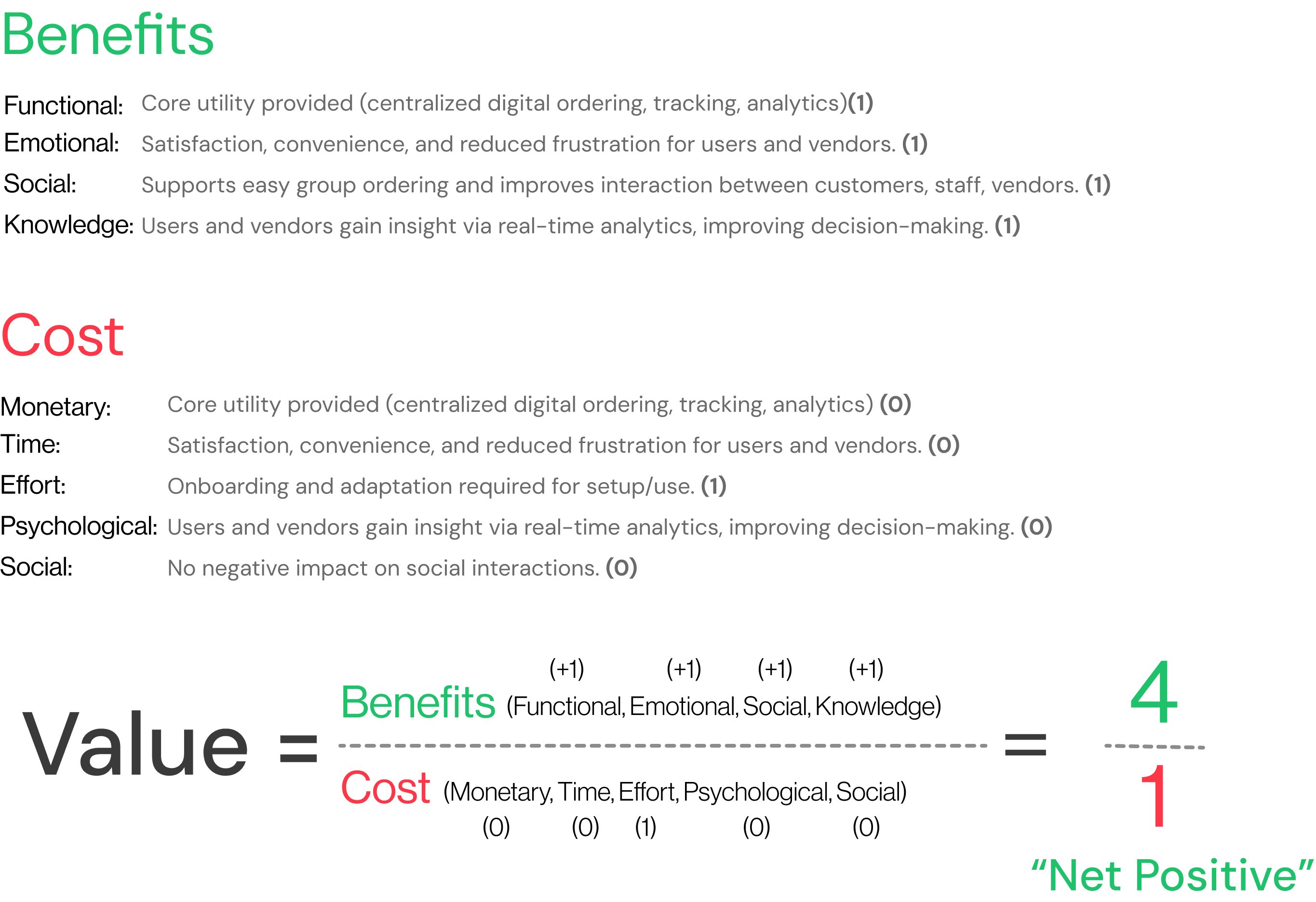
SERVICE VALUE EQUATION
The value equation compares user benefits to the costs they
incur, showing how much value the service delivers. A higher
ratio means greater benefits with less effort, indicating a strong
value proposition.

FINAL SERVICE CONCEPT
Plattr is a centralized digital ordering and operations system
designed specifically for food courts. It replaces fragmented,
stall-by-stall interactions with one unified platform that
connects customers, vendors, and kitchens into a seamless
workflow. Instead of standing in long queues, shouting orders
over the counter, and juggling multiple payments — Plattr
allows users to order from anywhere, combine items from
different vendors in one cart, and receive live updates until
their meal is ready for pickup.
HOW IS Plattr.
DIFFERENT AND BETTER
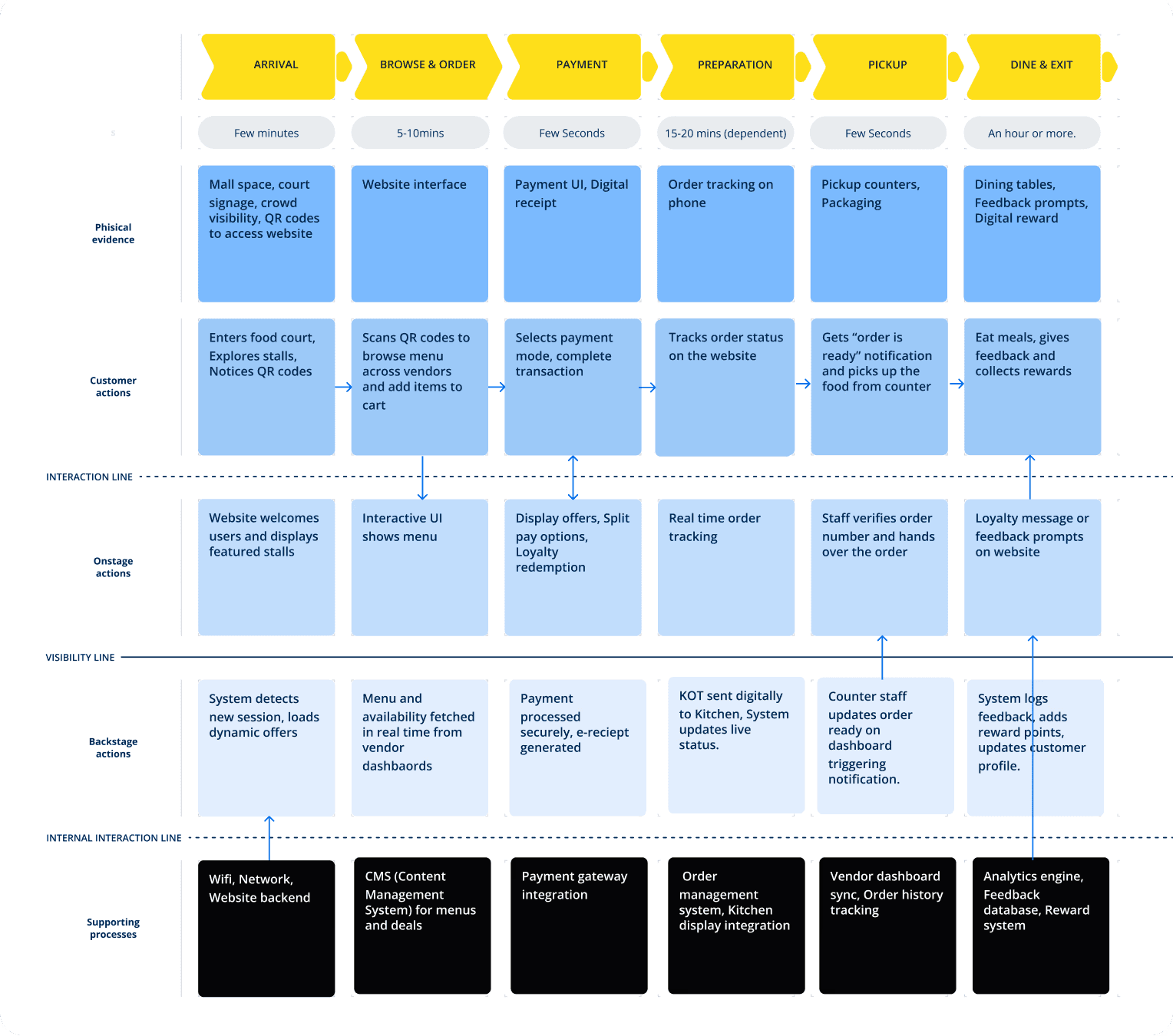
PROPOSED SERVICE BLUEPRINT
Our integrated platform unifies ordering, payments and
operations; streamlining the experience for customers,
vendors and staff.
Two more blueprints proposed for kitchen staff and
counter staff to ensure end-to-end service alignment.
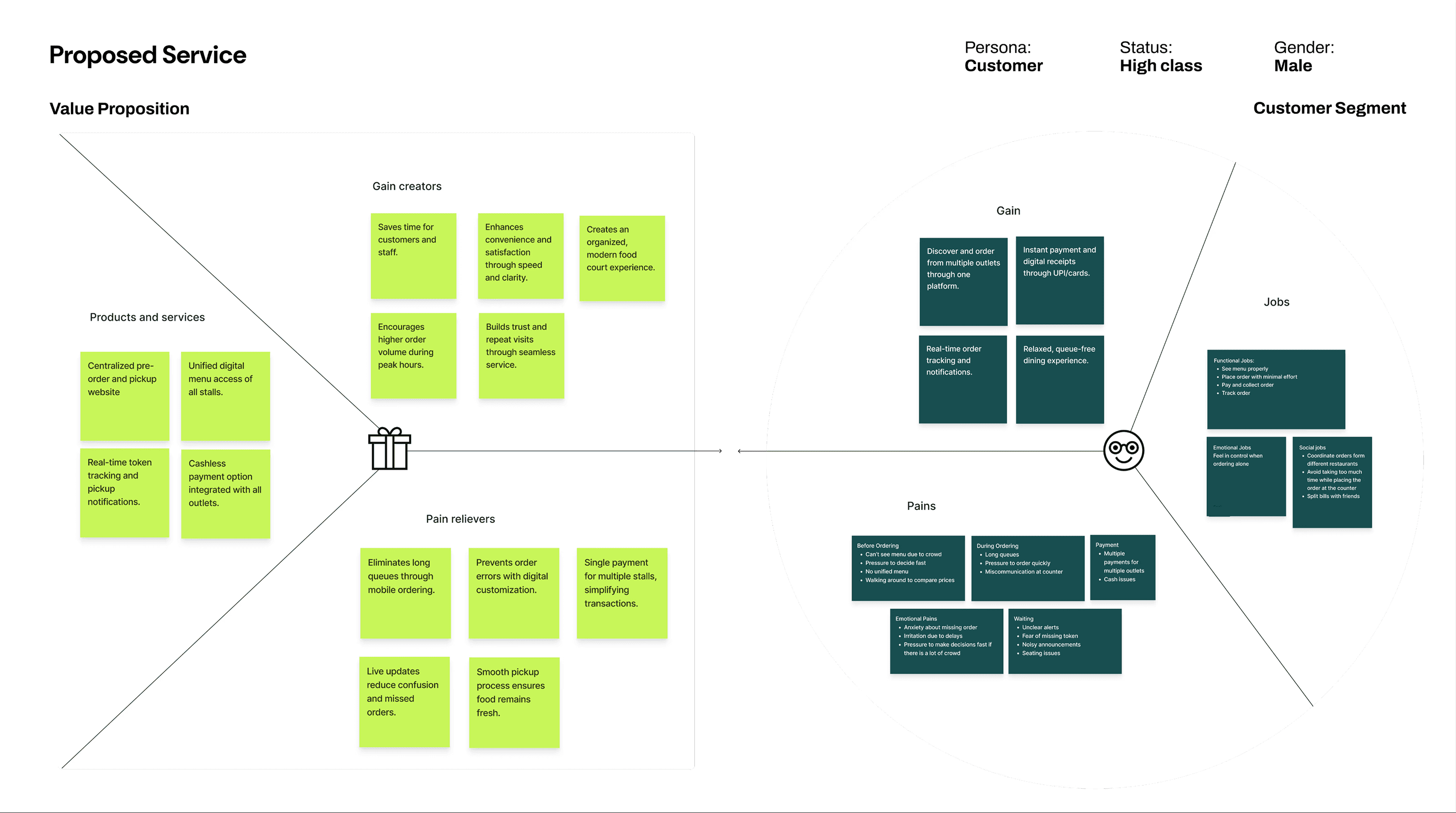
PROPOSED CVP
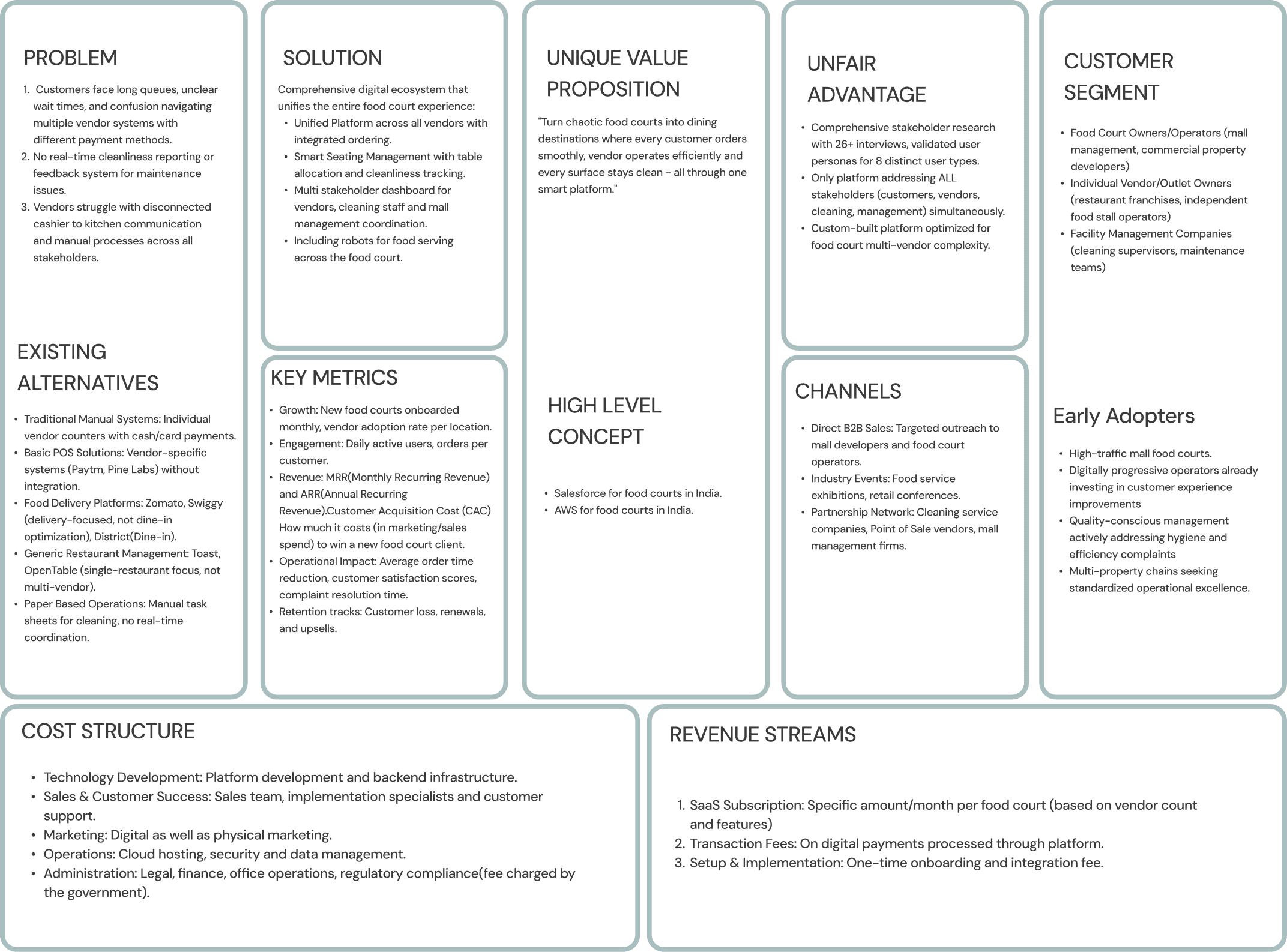
LEAN BUSINESS CANVAS
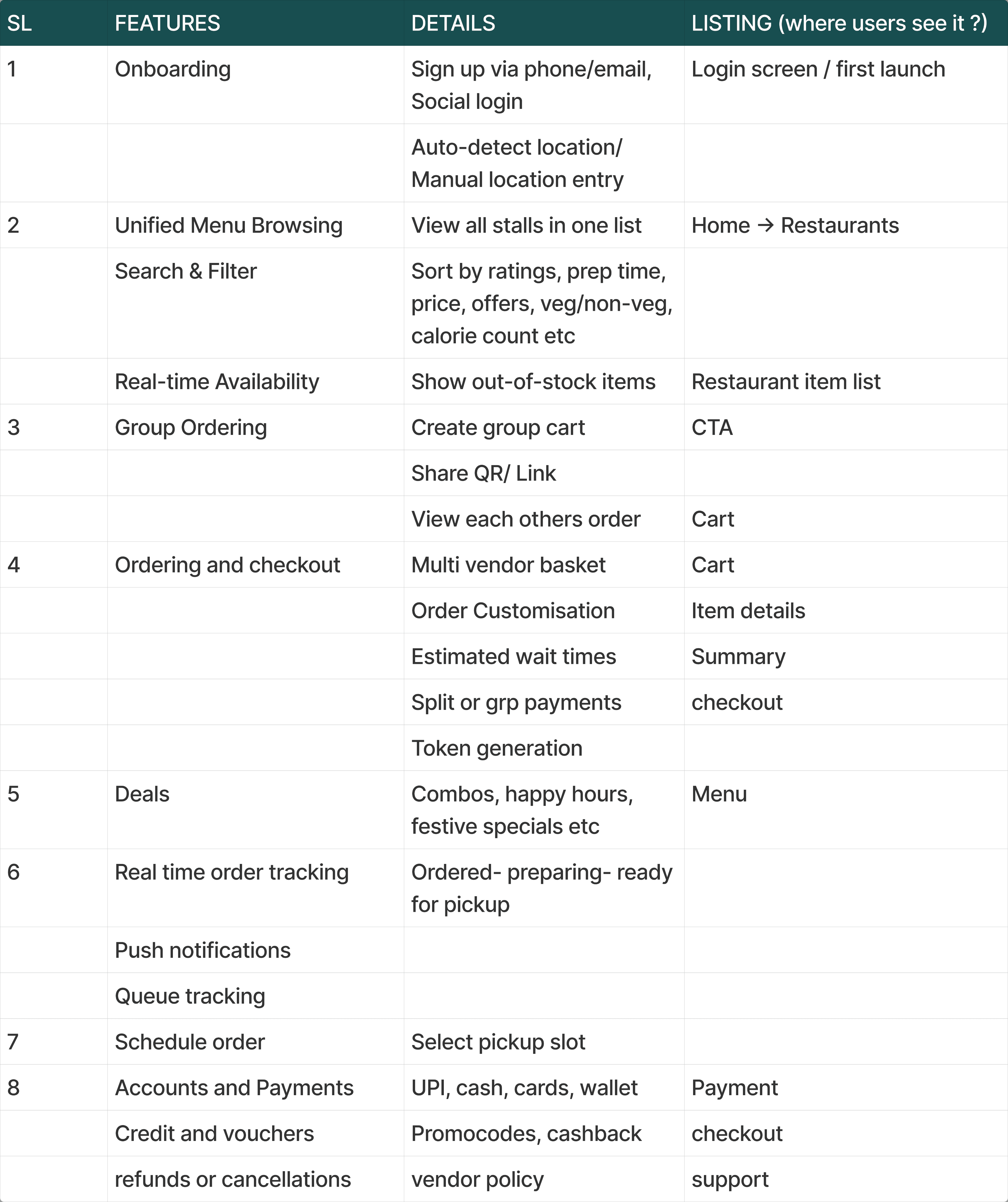
FEATURE LISTING
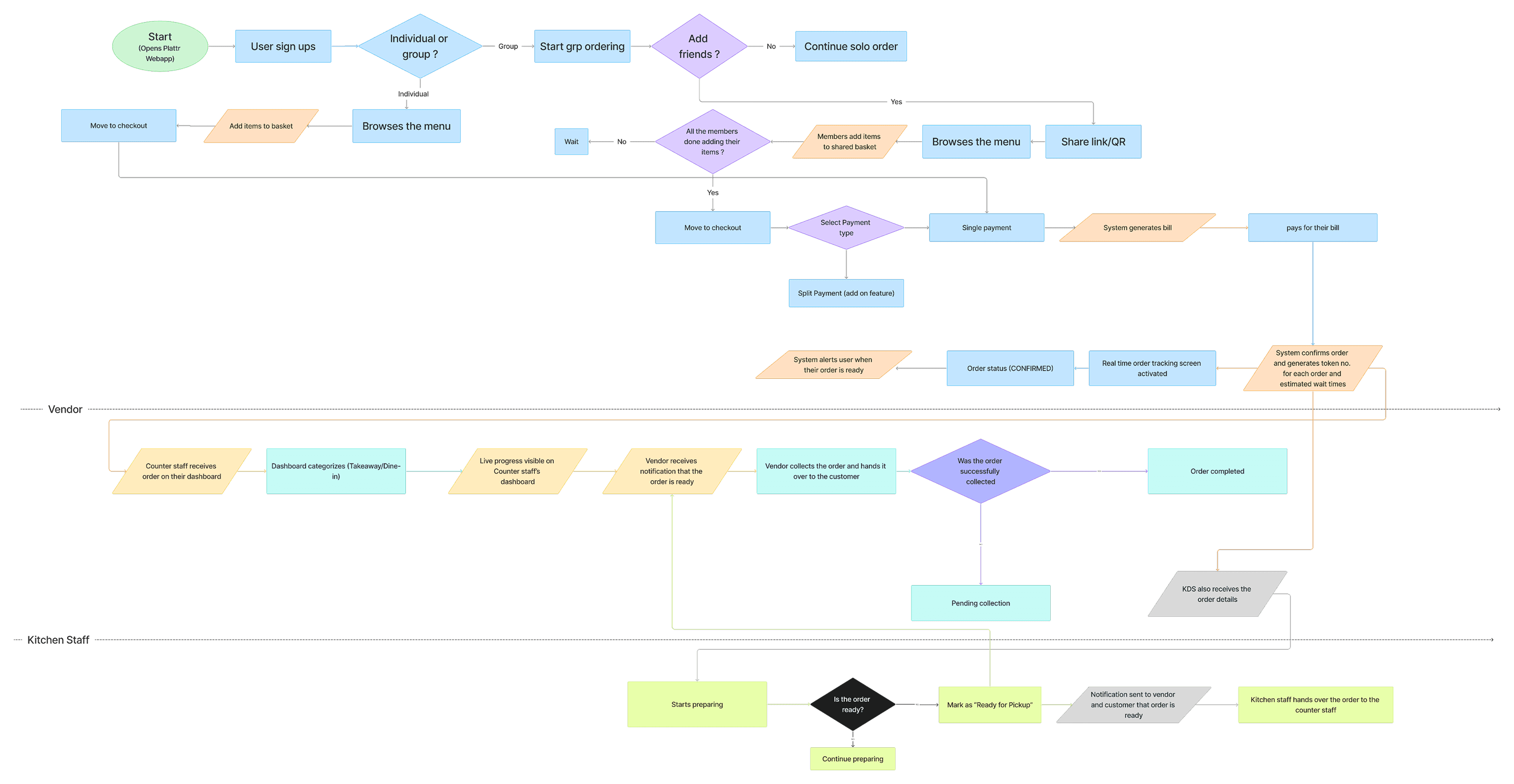
USER FLOW
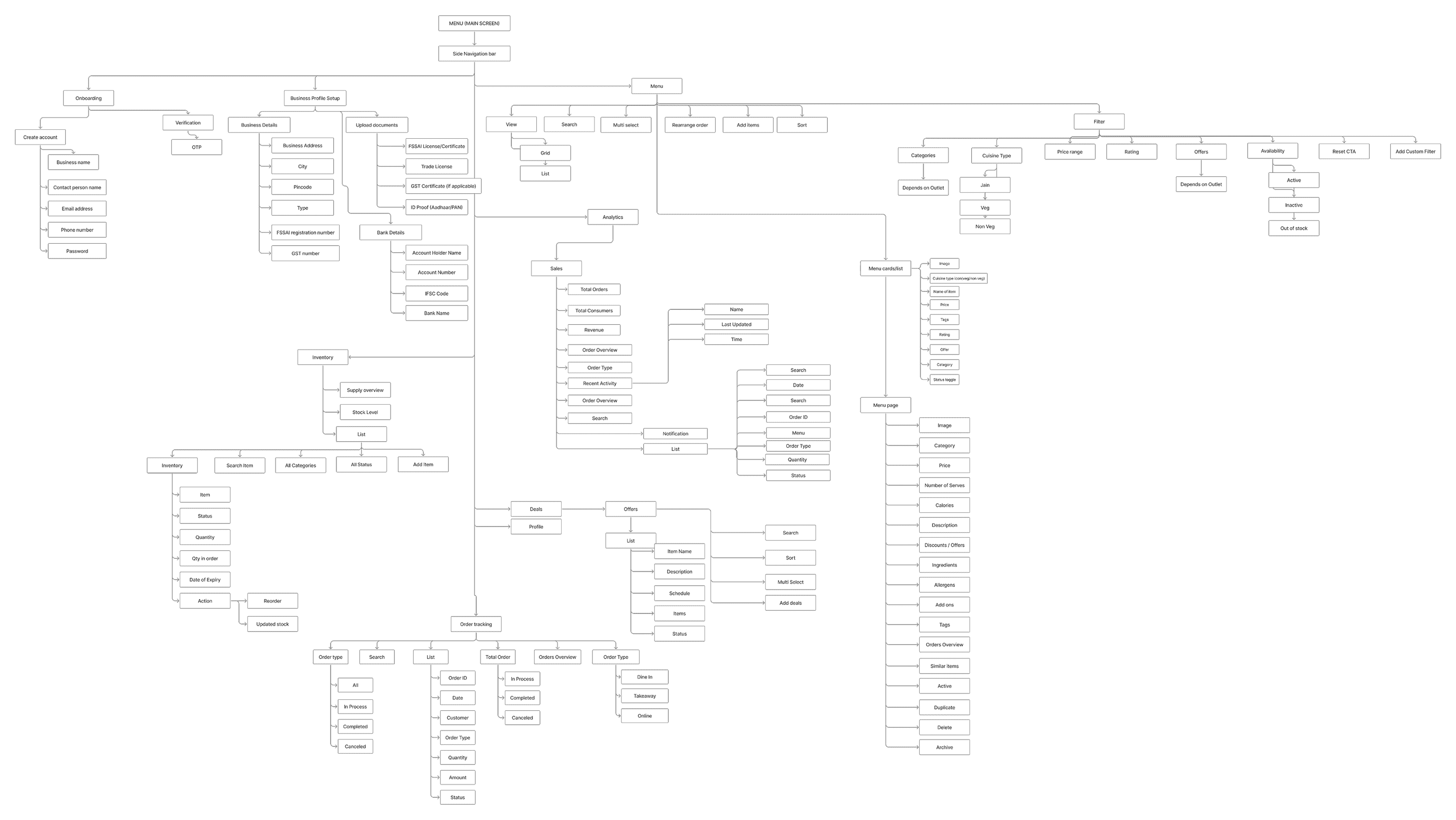
USER FLOW
PAPER PROTOTYPE
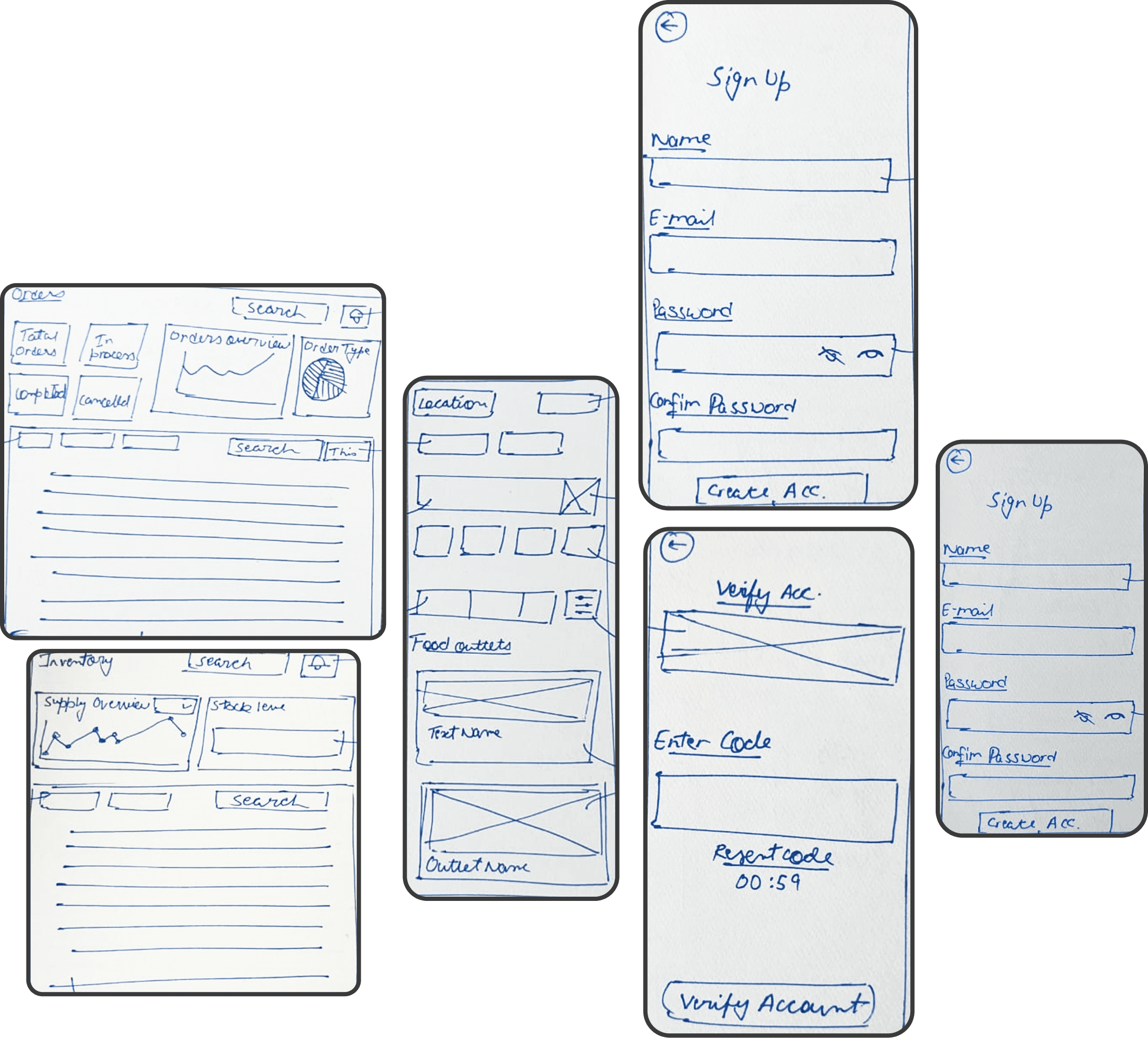
LO-FI WIREFRAMES